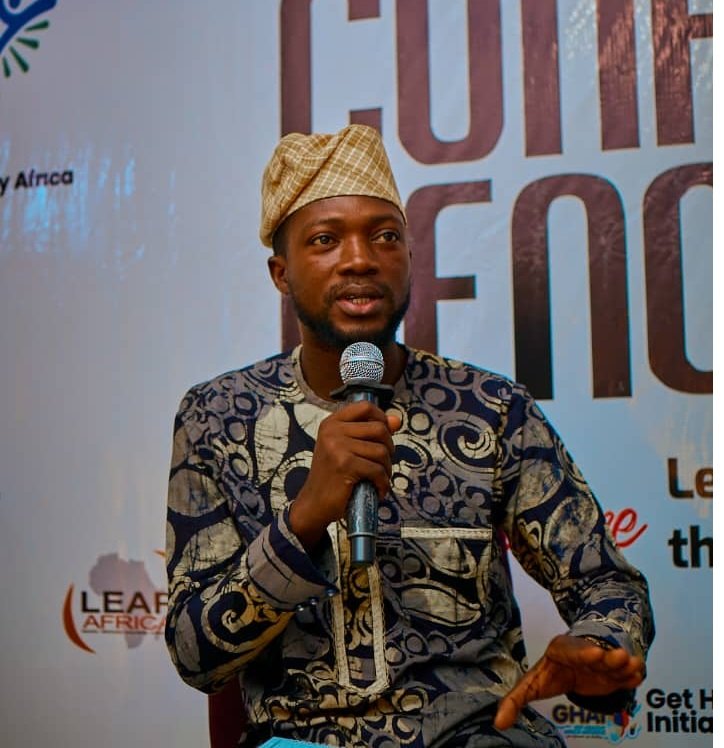
Development interventions are more likely to succeed when they are supported by political commitment from elites, mobilised citizens, capable government agencies, and formal and informal coalitions working together to drive reform, the Director of Uptake at the African Cities Research Consortium (ACRC), Ismail Ibraheem, a professor of Journalism and Communication Studies, has said.
Mr Ibraheem stated this while addressing the DevReporting team on the ACRC’s approach to urban transformation and the role of development journalism in supporting evidence-based interventions.
According to him, sustainable urban transformation requires development actors to understand the political, social and economic systems within cities and engage the different actors who influence how interventions are received, implemented and sustained.
He explained that the ACRC’s approach rests on four interconnected elements: political commitment from elites; formal and informal reform coalitions; citizens mobilised for change; and agencies capable of building short- and long-term state capacity.
Why informal actors matter in urban development
Mr Ibraheem illustrated the importance of informal actors by recalling the influence once wielded by Bayo Success, an informal leader in Oshodi in the 1980s, whom he compared with the influence of contemporary figures such as MC Oluomo.
Although such individuals may not hold formal political positions, he said their influence within communities determine how development projects are received.
“The World Bank may believe such calibre are not relevant, but when they put up a project and those area boys vandalise it, they will have no choice than to accept their fate,” he said.
According to him, the lesson is that development interventions cannot be separated from the realities of the communities where they are implemented.
He said this understanding is central to the work of the ACRC, whose lead institution is the University of Manchester.
The consortium, he explained, works across 12 cities in East, West, Central and Southern Africa, with a mission to catalyse sustainable urban transformation.
ACRC promotes ‘City of Systems’ approach
The Communication professor said Africa’s rapidly growing urban population has made it necessary for development actors to understand the interconnected systems that shape cities.
He said the ACRC approaches cities as “a city of systems”, examining political settlements, institutional structures and the relationships between different actors before implementing interventions.
He also referenced Makoko, where efforts to address housing and urban development challenges have sometimes failed to adequately consider the circumstances of residents.
According to him, development planners need to understand why people live in particular conditions before introducing solutions that could displace them.
“If the greatest priority of people is to feed, education will not be a priority,” Mr Ibraheem said, stressing that basic needs, security and access to essential services influence how communities respond to development programmes.
Strengthening interventions through community participation
Mr Ibraheem cited a waste management intervention in Oke-Rube, Lagos, as an example of how community participation can improve development outcomes.
The intervention involved residents and other stakeholders, including the community councillor and local government chairman, SDG office in Abuja, in efforts to improve waste management.
He said the project eventually attracted support from local, state and Federal Government authorities, demonstrating how community engagement can help development interventions gain wider institutional backing.
“ACRC is about sustainable urban transformation, how to build the capability of the government to do what they need to do, without blaming them, and for the good of the people,” he said.
He also pointed to a DevReporting-ACRC commissioned report on urban housing as an example of development reporting that examined the responsibilities of different actors rather than placing the burden entirely on the government.
Development Reporting must support change
Mr Ibraheem said the media’s role in development should extend beyond disseminating information to identifying problems, generating evidence and documenting solutions.
“In the past, people didn’t see the media as development partners, they saw the media just as platforms for the dissemination of information,” he said.
According to him, development journalism should contribute to the change process by producing evidence that can help policymakers, communities and development organisations understand problems and identify workable solutions.
“For DevReporting, we are part of the change process, not just reporting,” Mr Ibraheem said.
According to Mr Ibraheem, involving residents helps researchers understand communities from the perspective of the people who live there and encourages them to take ownership of interventions.
He said sustainability should ultimately be measured by whether an intervention changes how people think and act.
“If there’s a change of mindset, we have achieved our purpose,” he said.
Strengthening newsroom collaborations
The discussion also highlighted the importance of collaboration among news organisations in strengthening development journalism.
DevReporting’s Team Lead, Mojeed Alabi, said collaboration between newsrooms could improve the reach and quality of development reporting, adding that “the currency spent by newsrooms is collaboration.”
Mr Ibraheem affirmed that sustainable urban development cannot be achieved by government or development organisations working alone.
Political leaders, informal actors, community residents, researchers and journalists all form part of the systems that determine whether interventions succeed.
The challenge, he said, is therefore not only to design development projects, but to understand the people and relationships within communities and give them a role in sustaining the solutions intended to improve their lives.
-
Sodiq Mojibola is a Nigerian-based multimedia journalist. He has experience covering metro and environment beats.
View all posts